
Many people have asked for it, and now the planets have aligned! Learn the basic principles of traditional astrology with me this fall, and build the skills you need to interpret a chart.
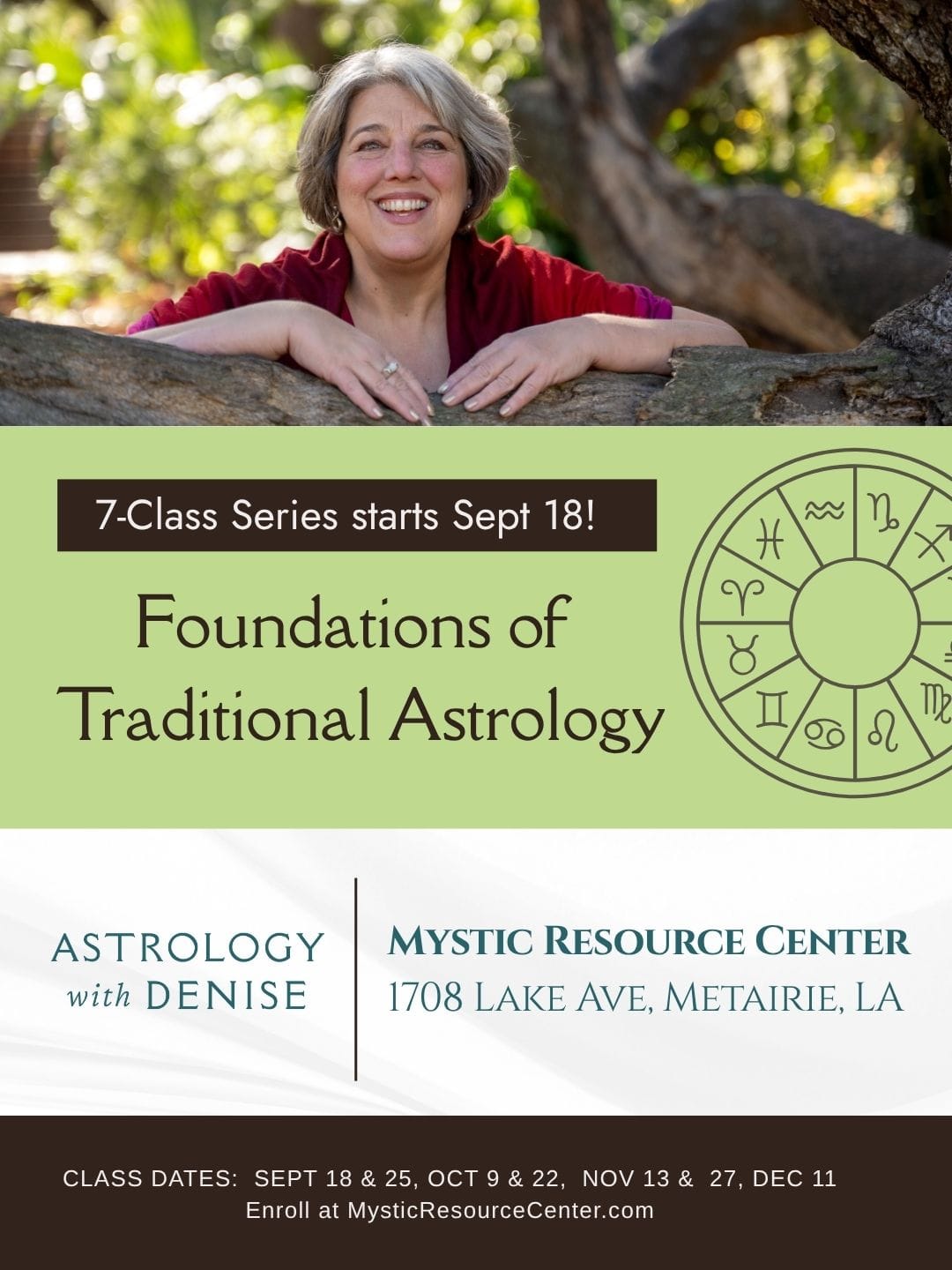
The course is designed for complete beginners and for practitioners trained in modern and psychological astrology. You'll progress from historical and philosophical foundations to the planets, signs, houses, and aspects, then finish with a practicum where you interpret real charts using the methods you've learned. No prior technical knowledge is required.
By the end, you'll be able to identify a planet's dignity in a sign, read the qualities and elements at play in a chart, apply house interpretations, and synthesize aspects and rulerships into a coherent picture. These building blocks will help you with birth charts (natal astrology) and give you a solid foundation for mundane, horary & electional astrology, and magical practice.
Other Upcoming Events
In-person
Friday, Aug 7, 7 pm - Astrology Night at Mystic
Saturday, Sept 12, 7 pm - Where is it? Finding the Answer with Horary Astrology
Sunday, Nov 22, 2:30 pm - The Magical Mansions of the Moon
Virtual
Mon, Aug 10, 7 pm - New Moon Webinar *Free for Jupiter tier subscribers, no registration required.
Foundations of Astrology Course Syllabus
Format - 7 two-hour sessions, delivered live and in person. Virtual sessions or videos may be offered as a backup should weather or other disruptions interfere.
Course Objectives - By the end of this course, learners will be able to:
- Explain the historical and philosophical basis of traditional astrology and how it differs from the psychological model
- Identify the traditional planets and their core significations
- Describe the twelve zodiac signs by quality, element, and mode
- Assess a planet's essential and accidental dignity in a chart
- Calculate and interpret major aspects and orbs
- Synthesize these elements into a full chart interpretation
Session 1: History, Philosophy, Qualities, and Elements
- Origins and history of astrology
- The philosophical assumptions underlying traditional practice: fate, fortune, character, and the ordering of the cosmos
- How traditional astrology differs from the twentieth-century psychological model
- The four qualities (hot, cold, wet, dry) and four elements (fire, earth, air, water) as the building blocks
.Session 2: The Ten Planets and Other Heavenly Bodies
- The seven traditional planets (Sun, Moon, Mercury, Venus, Mars, Jupiter, Saturn) and their core natures
- The outer planets (Uranus, Neptune, Pluto) and their influence
- Other points of interest are introduced, such as Lunar Nodes, lots (Arabic Parts), and fixed stars
- Planetary sect for diurnal and nocturnal charts
- Concepts of planetary motion
Session 3: Zodiac Signs and Mode
- The twelve signs as combinations of quality and element
- The three modes: cardinal, fixed, and mutable, and what each contributes to a sign's character
- Triplicities and how signs group by element across the zodiac
Session 4: Planet/Sign Delineations and Essential Dignity
- Essential dignity: rulership, exaltation, triplicity, term, and face
- Essential debility: detriment and fall, and what they indicate about a planet's expression
- How to read a planet's strength or weakness by sign placement alone, independent of house or aspect
- Combining dignity with the qualities and elements from Session 1 to build a fuller picture of a planet's condition
Session 5: Chart Dynamics, House Systems, and Accidental Dignity
- Overview of house systems
- Significations of each house
- Accidental dignity: angularity, house placement, and other situational factors that strengthen or weaken a planet
- Distinguishing essential dignity (a planet's inherent condition) from accidental dignity (its condition by circumstance)
Session 6: Aspects and Orbs
- Interpreting planetary motion
- The five traditional aspects: conjunction, sextile, square, trine, and opposition
- Orbs in traditional practice
- Applying versus separating aspects
- Reception, generosity, and mutual reception
- Brief introduction to declination and the parallel/contra-parellel, and out-of-bounds aspects
Session 7: Putting It All Together: Chart Interpretation Practicum
Recommended text: On the Heavenly Spheres, by Helena Avelar and Luis Ribeiro
Investment: $350 for the full course. Mystic offers an option to pay-as-you go, $50/class.
Classes are on Fridays, 7-9 pm, with one exception.
Sept 18
Sept 25
Oct 9
Oct 22 (Thurs)
Nov 13
Nov 27
Dec 11
You can change your email preferences to opt-out (or opt-in) to New Orleans-specific newsletters.